Phases
Complete lifecycle of the methodology: from Discovery to Delivery.
Problem-Driven AI is a methodology that progresses through five interdependent phases. It begins with Problem Phase, where the team validates that the problem is real before proposing anything. It continues with Solution Phase, where genuine consensus is reached on what to build and why. Context Phase translates that agreement into a precise system of Agents, Rules, and Skills that guides AI during construction. AI Build Phase materializes that context into a solution traceable back to the original problem. And Market Phase turns real-usage signals into continuous improvements to the context. Each phase is the precondition for the next.
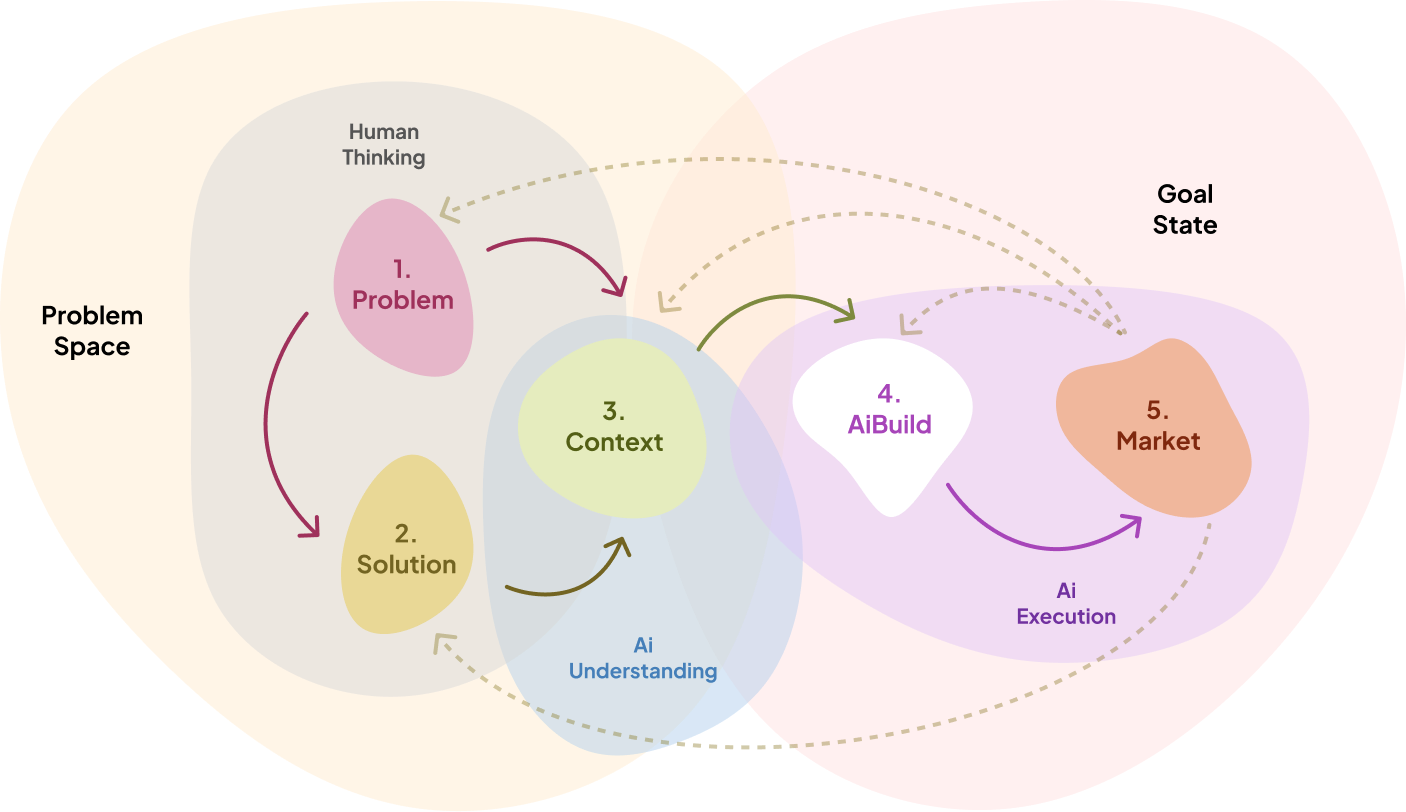
Explore each phase and understand what it does, who executes it, and why it exists before the time comes to apply it.
 1. Problem Phase
Active investigation with the people who live the problem to produce a precise, validated definition before thinking about solutions.
 2. Solution Phase
Iterative process to turn a well-defined problem into a solution with real organizational consensus, not just hierarchical approval.
 3. Context Phase
Translating human thinking into a system of Agents, Rules, and Skills that enables AI to build with precision and coherence.
 4. AI Build Phase
Materializing context into a built solution, protecting fidelity to the Problem Statement in every technical decision.
 5. Market Phase
Permanent regime of capturing and incorporating market signals so that each construction cycle is more precise than the last.